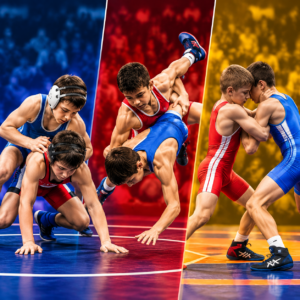
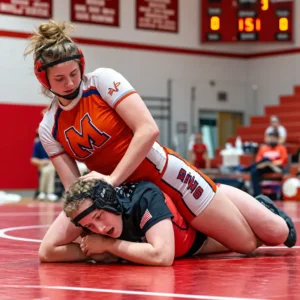
Walk into a wrestling room in the U.S and you may hear three style names in one practice. A coach talks about riding legs in folkstyle. Another wrestler is drilling a Greco-Roman headlock. Someone just got back from a freestyle tournament. They are all wrestling, but the rules, scoring, and strategy change a lot from one to the next.
The short version of the folkstyle, freestyle, and Greco-Roman difference is this. Folkstyle is the American school and college style, and it rewards control. Freestyle is an Olympic style that allows leg attacks and rewards quick scoring and exposure. Greco-Roman is the other Olympic style, and it bans attacks below the waist, so the match is built around the upper body.
This guide covers what each style is, how the scoring works, where each one is used, and how to choose. It ends with the gear a team needs, including custom wrestling uniforms.
A note before we start: wrestling rules differ by governing body, age group, and season. NCAA, NFHS (high school), USA Wrestling, and United World Wrestling (UWW) each publish their own rulebook, and rules get updated. Treat the numbers here as a map, and check the current rulebook for your event.
What Is Folkstyle Wrestling?
Folkstyle is the style used in most American youth, middle school, high school, and college wrestling. A match is won by pinning your opponent or by outscoring them across three periods.
Folkstyle is what most American wrestlers learn first. It is the style of state high school championships and the NCAA tournament. Other countries have their own traditional “folk” wrestling forms, but when Americans say folkstyle wrestling, they mean the scholastic and collegiate rule set.
What defines it is control. You score by getting the opponent to the mat, keeping them there, and getting out when you’re on the bottom.
- Takedowns: Taking an opponent from their feet to the mat and controlling them is worth 3 points under current NCAA and NFHS rules.
- Escapes: A wrestler on the bottom who gets free and faces their opponent earns 1 point.
- Reversals: Going from the bottom to control on top earns 2 points.
- Near falls: The top wrestler holds the opponent’s back close to the mat. Under current college and high school rules, that is 2 points for two seconds, 3 for three and 4 for four. High school rules also add a fifth point in certain injury situations.
- Pins: Holding both shoulders to the mat for the required time ends the match immediately.
- Riding time: College rules can award a point for a meaningful time advantage on top. High school rules generally don’t use riding time.
Folkstyle also has a referee’s position for the second and third periods, where one wrestler starts on top and the other on the bottom. That’s why bottom skills like stand-ups, sit-outs and switches matter so much. A wrestler who scores a lot on their feet but can’t get off the bottom will lose close matches.
A standard college match runs three periods (3-2-2 minutes). A high school match runs three 2-minute periods. Youth formats are often shorter and vary by program. A match ends early by technical fall at a 15-point lead.
What Is Freestyle Wrestling?
Freestyle is an international Olympic style that allows attacks on the whole body, including the legs, and rewards fast scoring through takedowns, throws, and exposure.
Freestyle is wrestled at the Olympic Games and World Championships under UWW rules. In the U.S., it is the main summer and off-season style for many folkstyle wrestlers, and women compete in it at the Olympic level.
Freestyle looks familiar to a folkstyle wrestler because leg attacks are legal. Single legs, doubles, and ankle picks all work. The scoring makes it a different game, though.
- Takedowns: Usually worth 2 points.
- Exposure: Turning the opponent’s back to the mat, even briefly, scores 2 points. There is no waiting for a near-fall count.
- Throws: Big, high-amplitude throws can score 4 or 5 points. This is where the style gets its reputation for explosive swings.
- Reversals and step-outs: A reversal is worth 1 point, and the opponent stepping out of bounds can score a point as well.
- Par terre: French for “on the ground.” This is the ordered ground position used after certain situations, such as a passivity call. The top wrestler gets a chance to score, and the bottom wrestler’s main job is defense.
- Technical superiority: A 10-point lead ends the match.
Freestyle doesn’t have folkstyle-style escapes, and there is no riding time. A match is two 3-minute periods for seniors, with a short break between. Points from both periods are added together.
Because exposure scores immediately and throws are worth so much, freestyle matches can change direction fast. A wrestler can be down by several points and back in the match after one gut wrench or a single big throw.
What Is Greco-Roman Wrestling?
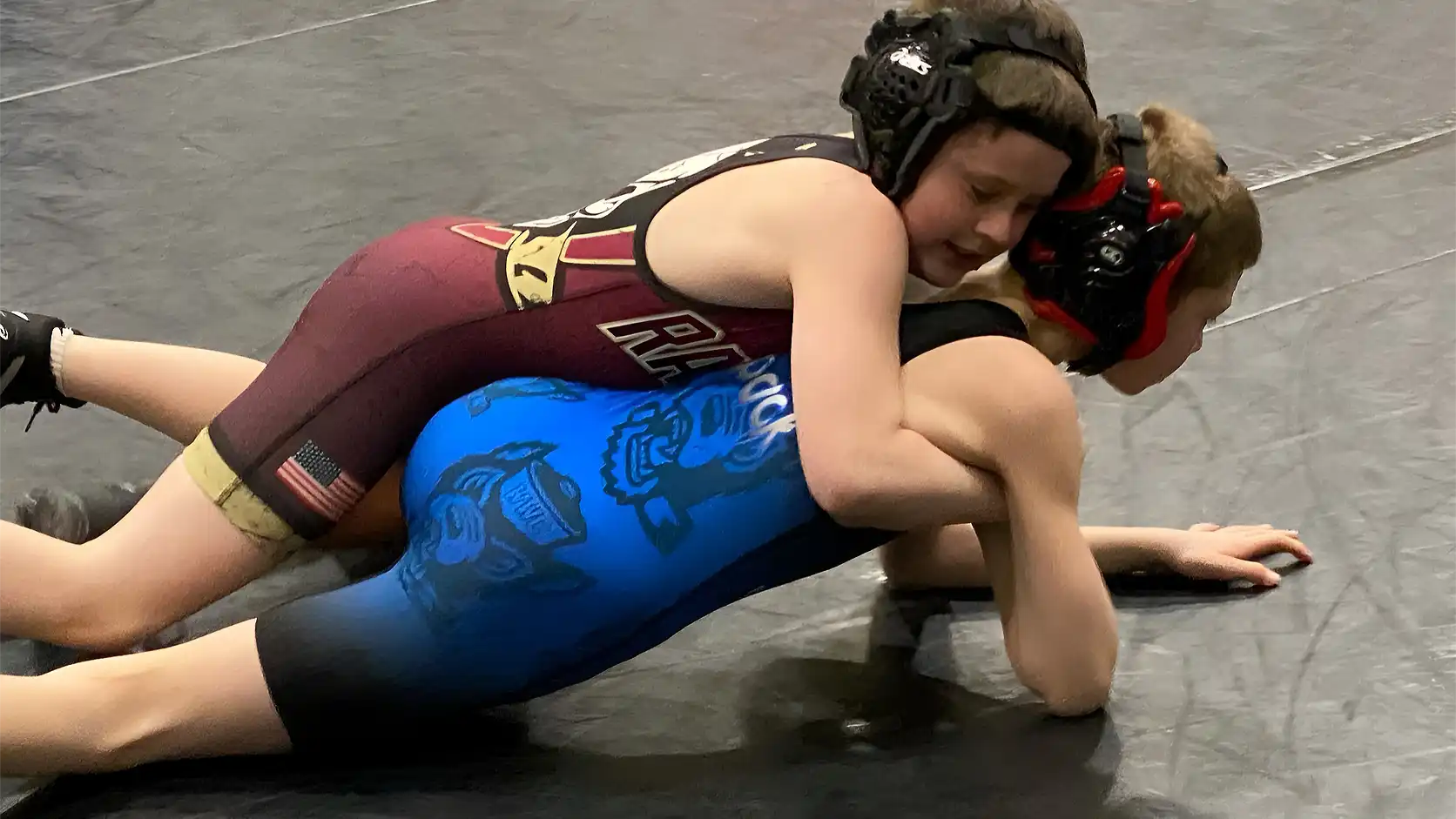
Greco-Roman is an international Olympic style where wrestlers can only attack and hold above the waist. Legs can’t be grabbed, tripped, or used offensively.
It shares UWW governance and the Olympic stage with freestyle. At the Olympic level, Greco-Roman is a men’s event.
With the legs off limits, everything happens from the hips up:
- Clinch work: Wrestlers spend a lot of time in tight upper-body ties: underhooks, overhooks, head control, body locks.
- Throws: Arm throws, headlocks, body-lock throws, and big lifts are the main source of points.
- Lifts: A strong body lock can take an opponent off the mat for a high-scoring throw.
- Par terre: The ordered ground position is a major part of the style. The top wrestler attempts lifts and gut wrenches to score. The bottom wrestler works to block them.
- Exposure: Same as freestyle: turning the back to the mat scores.
- Technical superiority: An 8-point lead ends the match, which is a smaller margin than freestyle’s 10.
Touching the legs or using the legs to trip is a rules violation and draws a penalty. This is why Greco-Roman is often low-scoring until a big throw lands.
Ready to Outfit Your Team?
Have an idea for your team’s colors, logo, names, and numbers? EVO9X can turn those ideas into custom wrestling uniforms and team gear, with a free design mockup before production.
Folkstyle vs Freestyle vs Greco-Roman: Quick Comparison
Rules vary by age group and organization. This table reflects current NCAA/NFHS folkstyle and UWW senior rules.
| Folkstyle | Freestyle | Greco-Roman | |
| Main purpose | American scholastic and collegiate competition | International and Olympic competition | International and Olympic competition |
| U.S. school/college use | Standard in youth, middle school, high school and college | Mostly club, offseason and national events (and women’s college competition in some cases) | Mostly club, offseason and national events |
| Olympic/international use | No | Yes | Yes (men) |
| Leg attacks | Allowed | Allowed | Not allowed |
| Takedown | 3 points | Usually 2 points | Usually 2 points |
| Escape | 1 point | No escape point | No escape point |
| Reversal | 2 points | 1 point | 1 point |
| Near fall / exposure | Near fall: 2/3/4 points, based on hold time | Exposure: 2 points, immediate | Exposure: 2 points, immediate |
| Throws | Same as a takedown (3 points) | 4–5 points for high amplitude | 4–5 points for high amplitude |
| Par terre | No | Yes | Yes |
| Match structure | College 3-2-2; high school 3 × 2 minutes | Two 3-minute periods (seniors) | Two 3-minute periods (seniors) |
| Technical fall/superiority | 15 points | 10 points | 8 points |
| Scoring emphasis | Control and positions | Quick scoring and exposure | Upper-body throws and lifts |
| Overall feel | Methodical, position-based | Fast, scrambly | Tight, power-based |
The Biggest Differences Between Folkstyle, Freestyle and Greco-Roman
These are the differences that change how a wrestler trains, so they’re worth a closer look.
1. Leg Attacks
Folkstyle and freestyle allow attacks on the legs. Greco-Roman doesn’t. That one rule changes the whole stance and entry game. A freestyle wrestler can shoot from distance. A Greco wrestler needs to get close and create a clinch.
2. Control and Riding
Folkstyle is the only one of the three that is built around control. The top wrestler tries to keep the opponent down and work for turns, and the bottom wrestler must earn an escape or reversal. Freestyle and Greco-Roman don’t reward long control. The match is more about scoring actions than holding position.
3. Exposure and Near Falls
Folkstyle near falls depend on how long the back is held close to the mat. International exposure scores the moment the back turns, which makes quick exchanges more valuable. This difference is why a folkstyle wrestler can feel “stuck” at first in freestyle: moves they would hold on to in folkstyle are already finished.
4. Escapes and Reversals
Folkstyle has an escape (1 point) and a bigger reversal (2 points). International styles drop the escape point and give a smaller reversal (1 point). In freestyle and Greco, the bottom wrestler’s job in par terre is mostly defense.
5. Throws and Upper-Body Attacks
In folkstyle, a throw scores like any other takedown. In freestyle and Greco-Roman, big throws pay far more. That’s why Greco-Roman wrestlers drill upper-body techniques so heavily and why freestyle wrestlers use throws as a way to swing a match.
6. Scoring
Technical fall at 15, 10 and 8 points is the easiest example of how differently the three are tuned. Folkstyle rewards a patient lead, while the international styles end matches earlier. The next section goes through each scoring action.
7. Match Strategy
- Folkstyle: Win positions. Score on your feet, ride, and don’t give up easy escapes.
- Freestyle: Be active and ready to score in scrambles. Passivity can be penalized, so staying on the attack matters.
- Greco-Roman: Win the tie-up. One good lift or throw can decide a match.
How Wrestling Scoring Differs in Each Style
Here is the scoring broken out by action. Again, these reflect current NCAA/NFHS folkstyle and UWW senior rules. Age-group and event rules can differ, and USA Wrestling applies UWW rules at many of its events, with some age-specific adjustments.
- Takedown: 3 points in folkstyle. 2 points in the international styles, with throws worth more.
- Escape: 1 point in folkstyle only.
- Reversal: 2 points in folkstyle. 1 point in freestyle and Greco-Roman.
- Near fall (folkstyle): 2, 3 or 4 points depending on how long the position is held. In high school, a fifth point applies in certain injury situations.
- Exposure (international): 2 points when the back is turned to the mat.
- Throws: Same as a takedown in folkstyle. 4 or 5 points in the international styles for high-amplitude throws.
- Pushouts and step-outs: Not a scoring action in folkstyle. In the international styles, the opponent going out of bounds can score a point in certain situations.
- Pins: End the match in all three styles. The required hold time is longer in folkstyle than in the international styles.
- Technical fall/superiority: 15 points in folkstyle. 10 in freestyle. 8 in Greco-Roman.
When two international wrestlers are tied on points, criteria such as the highest-value scoring action and the last point scored decide the winner. Folkstyle uses overtime periods.
Which Style Is Harder: Folkstyle, Freestyle or Greco-Roman?
No style is objectively harder. Which one feels hardest depends on the wrestler’s strengths, conditioning, technique and experience.
Each style asks for something different:
- Folkstyle tests endurance, positioning and the ability to grind through top and bottom.
- Freestyle tests speed, scrambling and defense against sudden exposure.
- Greco-Roman tests upper-body strength, body awareness and the ability to finish throws in a clinch.
A strong folkstyle wrestler can look lost in their first Greco-Roman practice. A Greco wrestler might struggle with leg defense. That doesn’t mean one style is easier. It shows how specific each skill set is.
Competition level matters too. The hardest thing about a style is usually whatever you haven’t trained yet.
Can You Train in All Three Wrestling Styles?
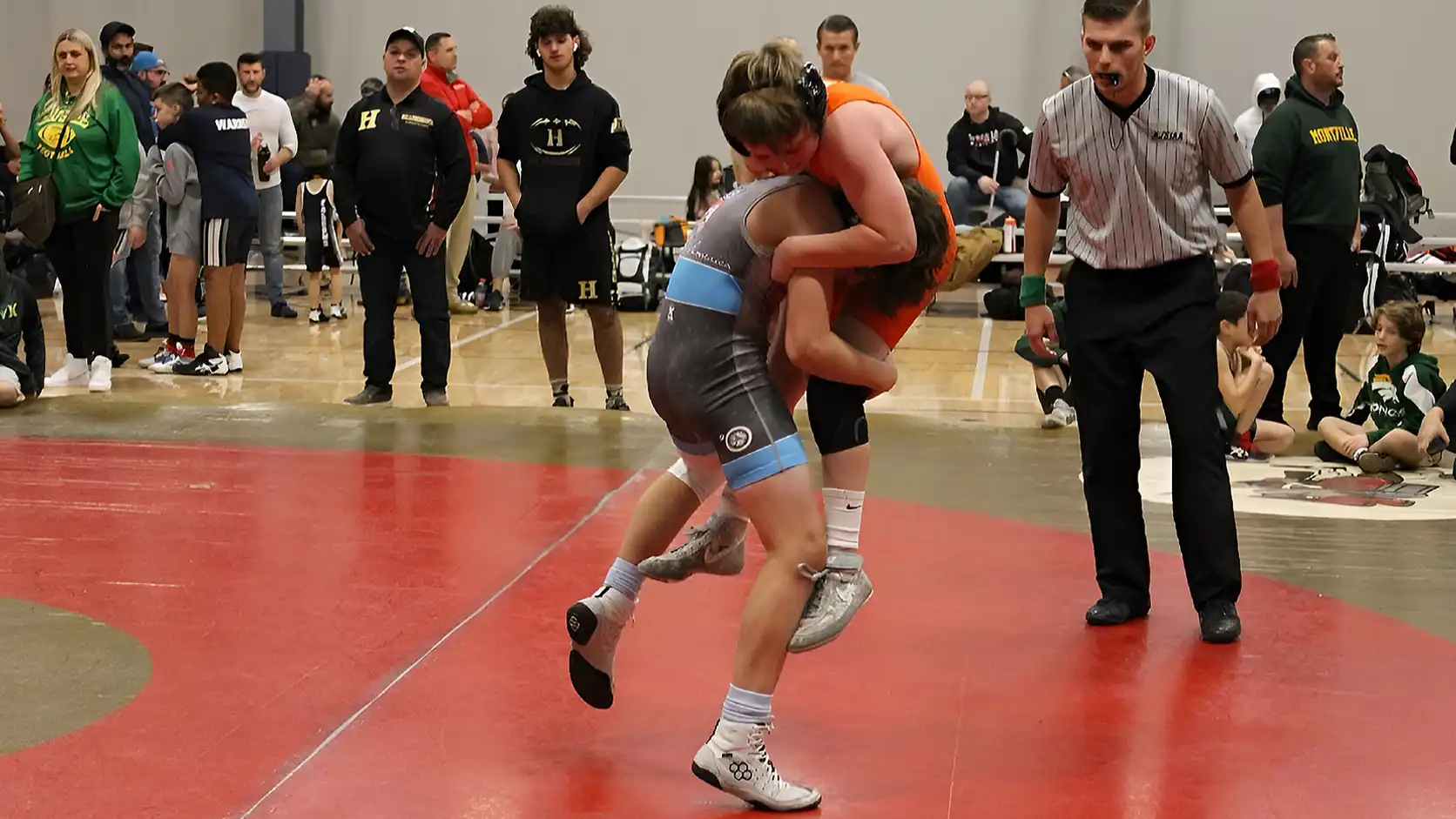
Yes. Many U.S. wrestlers train in all three, and skills carry over in both directions.
- Folkstyle teaches control. Riding, bottom escapes and good positioning help in any style, especially in par terre defense.
- Freestyle teaches scrambling. Quick exposure and explosive attacks make folkstyle wrestlers more dangerous in transitions.
- Greco-Roman teaches upper-body control. Hand fighting, body positioning and throws improve any wrestler’s tie-ups.
Some things don’t transfer cleanly. A folkstyle wrestler who holds a position for a near fall may not score in freestyle. A freestyle wrestler used to a big throw may find it only worth a takedown in folkstyle. Training in more than one style means learning both what carries over and what has to change.
Training several styles also helps over a long season. Many wrestlers do folkstyle in winter, then freestyle or Greco-Roman in spring and summer.
Which Wrestling Style Is Best for Beginners?
For most U.S. beginners, the best style is whichever one their local program teaches. There isn’t one universal winner. These are the practical factors:
- Age: Most young wrestlers start in folkstyle because that’s what local youth clubs and school programs run.
- Local program: Your club, school and region decide what’s available. A coach who knows a style well matters more than the style label.
- School opportunities: If a high school team is the goal, folkstyle is the style that team will wrestle.
- Coach: A good coach in any style will teach fundamentals that carry over.
- Competition goals: Folkstyle for school seasons. Freestyle or Greco-Roman for national and international events.
- College goals: College programs wrestle folkstyle for the main season, so folkstyle experience is useful for recruiting. Strong freestyle credentials are also valued by many programs.
- International/Olympic goals: Freestyle or Greco-Roman is needed eventually. The earlier a wrestler adds one of them, the more time they have to adjust.
If you’re a parent unsure where to start, ask the local club what they teach and when the season runs. Then consider adding a second style once your wrestler is comfortable with the basics.
Ready to Outfit Your Team?
Have an idea for your team’s colors, logo, names, and numbers? EVO9X can turn those ideas into custom wrestling uniforms and team gear, with a free design mockup before production.
Folkstyle, Freestyle and Greco-Roman for U.S. Wrestlers
The U.S. has a split system, and knowing how it fits together helps you plan.
- Youth wrestling: Folkstyle is the common default, though many clubs and USA Wrestling events also offer freestyle and Greco-Roman. Formats and rules vary by event.
- Middle school: Typically folkstyle, following local league rules.
- High school: Folkstyle under NFHS rules, with state associations setting the details.
- College: Folkstyle under NCAA rules for the main season. Women’s college wrestling at the NCAA level uses freestyle, according to recent reporting on the NCAA’s decision.
- Offseason wrestling: Freestyle and Greco-Roman tournaments are widely used for spring and summer competition.
- Freestyle and Greco-Roman development: Clubs, camps and regional programs offer training in both styles, and USA Wrestling runs the national structure for them.
- International competition: Freestyle and Greco-Roman are the styles at the World Championships and Olympics, so athletes aiming there will need one of them.
For a U.S. wrestler, folkstyle is the foundation most of the time, with freestyle and Greco-Roman as add-ons.
What Gear Do Wrestlers Need?
Whatever the style, wrestlers need gear that moves with them and holds up through hard use. Teams that order in volume often look for custom sports uniforms in the USA so everyone’s gear matches in fit, color and branding.
The basics:
- Wrestling singlets: The standard competition uniform in all three styles. The fit should be snug but not restrictive, since loose fabric can be grabbed.
- Compression gear: Often worn under or around training clothes for comfort and layering.
- Shorts: Common for practice and training.
- Warm-up apparel: Jackets, pants and tees for staying warm between matches.
- Team gear: Matching tops, bags and warm-ups that tie the team together.
Details that matter day to day:
- Breathable fabrics: Wrestling rooms get hot. Fabric that moves moisture helps comfort.
- Proper fit: A singlet that rides up, sags or pinches becomes a distraction.
- Mobility: Wrestlers need full range for shots, throws and scrambles.
- Team colors and logos: Matching colors and logos help a team look unified at tournaments.
- Customization: Names, numbers, school or club marks and color choices make a team’s gear its own.
EVO9X makes custom sports uniforms, including wrestling gear, for teams and clubs. If you’re building a team look, the custom wrestling uniforms page is the best place to see what’s possible.
How to Choose Wrestling Gear for Your Team
A few questions help narrow it down.
- Fit: Order sizes based on actual measurements, and check sizing guidance before you commit. EVO9X lists sports uniform fabrics and sizing details that are worth reading before you place an order.
- Comfort: Wrestlers wear this gear for hours. Look at seams, fabric feel and how it handles sweat.
- Mobility: Check that the cut allows deep shots, bridging and full hip movement.
- Breathability: Fabric choice matters in warm rooms and long tournament days.
- Durability: Mats, mat burn and washing take a toll. Gear should hold its shape and color.
- Customization: Decide on colors, logo placement and any names or numbers early so everything matches.
- Team identity: Gear is how a team gets recognized at a crowded tournament. Consistent color and branding help.
- Level requirements: Youth programs, high school teams and club teams can have different uniform rules. Check with your league, school or state association before ordering, since requirements vary.
Ordering for a whole roster is easier when you know the process up front. You can see EVO9X’s custom uniform process before you request a quote.
Folkstyle, Freestyle and Greco-Roman Difference: Final Takeaways
The folkstyle, freestyle and Greco-Roman difference comes down to three questions: Can you attack the legs, how do points get scored, and what is the style for?
- Folkstyle is the American school and college style. It rewards control and a full range of positions.
- Freestyle allows leg attacks and rewards quick exposure and big throws.
- Greco-Roman bans leg attacks and focuses on upper-body throws and lifts.
You don’t have to pick one forever. Most wrestlers start with whatever their local program offers, build fundamentals, and add a second style when they’re ready. If you’re equipping a team along the way, EVO9X offers custom team uniforms.
Frequently Asked Questions
What is the difference between folkstyle and freestyle wrestling?
Folkstyle is the American school and college style, and it rewards control, escapes, and near falls. Freestyle is the international style, and it rewards quick exposure and big throws. Both allow leg attacks.
What is the difference between freestyle and Greco-Roman wrestling?
Freestyle allows attacks on the whole body. Greco-Roman allows holds and attacks only above the waist. Both use international rules and are wrestled at the Olympics.
Is Greco-Roman harder than freestyle?
Neither is objectively harder. Greco-Roman asks for more upper-body strength and clinch skills, while freestyle asks for leg defense and scrambling. Difficulty depends on the wrestler.
Can you use leg attacks in Greco-Roman?
No. Grabbing or attacking the legs, or using the legs to trip, is a violation and draws a penalty.
Is folkstyle only wrestled in the United States?
Folkstyle as a rule set is mainly American. Many countries have their own traditional folk wrestling forms, but they are different sports.
Do high school wrestlers compete in freestyle?
Yes, many do, usually outside the school season. High school season matches are folkstyle, while freestyle events are common in the spring and summer.
Can a wrestler train in all three styles?
Yes. Each style builds different skills, and many wrestlers rotate through them across the year.
Which wrestling style is best for beginners?
The best one is usually whatever your local club or school teaches. Folkstyle is the most common starting point in the U.S.
Why is folkstyle important for U.S. wrestlers?
It is the style used in youth, high school, and college competition. A wrestler’s school career and college path mostly run through folkstyle.
What gear does a wrestler need?
At minimum, a singlet and wrestling shoes, plus headgear if required by your league. Many wrestlers also use compression gear, shorts, and warm-ups. Check your league’s rules for required items.